China and Xi Jinping’s Official Position on the South Korea Meeting
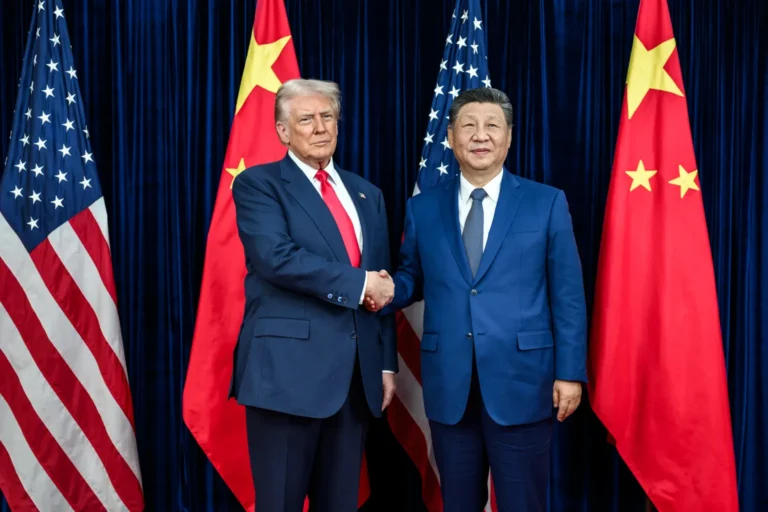
China’s response to the Trump–Xi meeting was carefully calibrated to project both openness to engagement and firm protection of national interests. While Xi Jinping did not issue a lengthy, personal press conference, Chinese statements — released mainly through the Foreign Ministry and state media — collectively outlined Beijing’s interpretation of the meeting’s significance. The primary themes in China’s messaging emphasized stability, mutual respect, and a return to predictable strategic communication with Washington.
Officials highlighted that the session in Seoul was “constructive and candid,” signaling progress without suggesting that China conceded on any core policy positions. The Chinese Foreign Ministry asserted a desire to “manage differences responsibly” and guide the bilateral relationship “back to the track of sound and stable development.” This language reflects China’s ongoing priority: preventing uncontrolled escalation while avoiding the appearance of weakness.
From a regional perspective, China linked the meeting to peace and stability in the Asia-Pacific, particularly the Korean Peninsula. Beijing stressed that external actors — a subtle reference to U.S. alliances — should avoid actions that create “confrontational blocs” in Asia. This position underscores China’s broader strategic objective: ensuring that Asian security is shaped primarily by Asian powers, with Beijing playing the role of central stabilizer.
At the same time, Xi Jinping reaffirmed China’s firm opposition to U.S. actions viewed as strategic containment, including technology export controls, trade restrictions, and military cooperation with Taiwan. China insists that cooperation must occur on the basis of “equality and mutual benefit,” clearly signaling that any attempt to pressure Beijing through economic or military leverage will be resisted.
State media further framed the meeting as a demonstration of China’s growing diplomatic weight. By hosting the event in South Korea’s neighborhood — a sensitive area for Beijing — China portrayed itself as the regional anchor, while the United States was depicted as a necessary but external participant. Analysts in Chinese publications argued that global stability, especially in South Asia and the Western Pacific, increasingly depends on how Washington chooses to acknowledge China’s leadership role.
Notably, Beijing avoided explicit comments on issues where its interests diverge sharply from Washington — such as U.S. cooperation with India and pressure on Russia over the Ukraine conflict. This strategic ambiguity suggests that while China seeks normalization with the U.S., it will not compromise on its “no-limits” partnership with Moscow or its competitive positioning against India.
Chinese Foreign Ministry Statements Summary:
- Focus on “stability, dialogue, and mutual respect”
- Emphasis that China wants to manage competition responsibly
- Highlighted that the meeting was “constructive” and “candid”
- Stressed cooperation on:
- Trade
- Regional security
- People-to-people exchanges
- Technology relationship boundaries
A spokesperson said China hopes both sides will “push US-China relations back onto the track of sound and stable development.” (This is very similar language China uses after all high-level U.S. meetings — signaling progress without revealing concessions.)
Proudly powered by WordPress